


Tracing the Health of Your Ancestors and Why a Family Medical History Belongs in Your Tree
Genealogists are used to collecting names, dates, and places, the scaffolding of a family tree. But there is another kind of inheritance hidden in those same branches, one that can matter as much to the living as to the memory of the dead. Woven through every lineage is a pattern of health, the conditions that recurred across generations, the ages at which relatives fell ill, the causes that appear again and again on death certificates. Assembling this into a family medical history turns genealogy from a backward-looking hobby into something quietly practical, a tool that can help you and your relatives understand your own risks and act on them.
The reason this works is that families share more than surnames. They share genes, and very often they share environments, diets, and habits too. Together, those factors mean that certain conditions tend to run in families, and noticing the pattern is genuinely useful. A well-built family health history can flag a higher-than-usual chance of common disorders such as heart disease, high blood pressure, stroke, type 2 diabetes, and certain cancers. It cannot diagnose anything, and it is not destiny, but it can tell a doctor where to look and when, which is exactly the kind of foresight modern medicine values.
What you are building is a record of health information about you and your close blood relatives, and the guidance from health authorities is consistent on how far it should reach. A complete history covers about three generations: yourself, your siblings and children, your parents, your aunts and uncles, your grandparents, and your cousins. Beyond that circle the genetic relationship thins out enough that the information becomes less predictive, though it is still worth noting anything you happen to learn. The closer the relative and the more of them affected by the same condition, the more weight it carries.
For each person, a few specific details do most of the work, and they are the same details a genealogist is often halfway to collecting already. Record the major medical conditions each relative had. Note the age at which each condition was diagnosed, because age is the single most informative piece of the puzzle. Heart disease in an eighty-year-old is unremarkable; heart disease in a thirty-year-old may hint at an underlying genetic factor, and it might prompt a doctor to start screening you years earlier than the standard age. For relatives who have died, record the age at death and the cause if it is known, since several relatives dying younger than expected can itself be a signal. Finally, note ethnic background, because some populations carry elevated risk for specific inherited conditions, and that context helps a clinician interpret the rest.
Gathering all this means doing what genealogists do best: talking to relatives. The easiest way to learn a family’s health history is simply to ask, and family gatherings, the reunions and holidays and even funerals where relatives come together, are natural moments to start. There is a craft to these conversations. Keep questions short, avoid ones that invite a flat yes or no, and use gentle follow-ups like “can you give me an example.” Do not expect anyone to remember everything; people frequently misremember or never knew their exact condition, so check and double-check rather than assume. Recording the conversation, with permission, lets you go back over it later for details missed in the moment. And it pays to listen for the old euphemisms, because a relative who suffered from “the blues” may well have had depression, and one who “had a weak heart” may point to something a cardiologist would recognize.
When living memory runs out, the documentary trail that genealogists already follow can fill the gaps. Death certificates often state a cause of death directly. Obituaries sometimes mention a long illness. Old medical records, where they survive, are gold. This is where the two pursuits, family history and family health history, genuinely reinforce each other, since the same census entry or parish record that places an ancestor in time can also, with a death certificate alongside it, tell you what they died of.
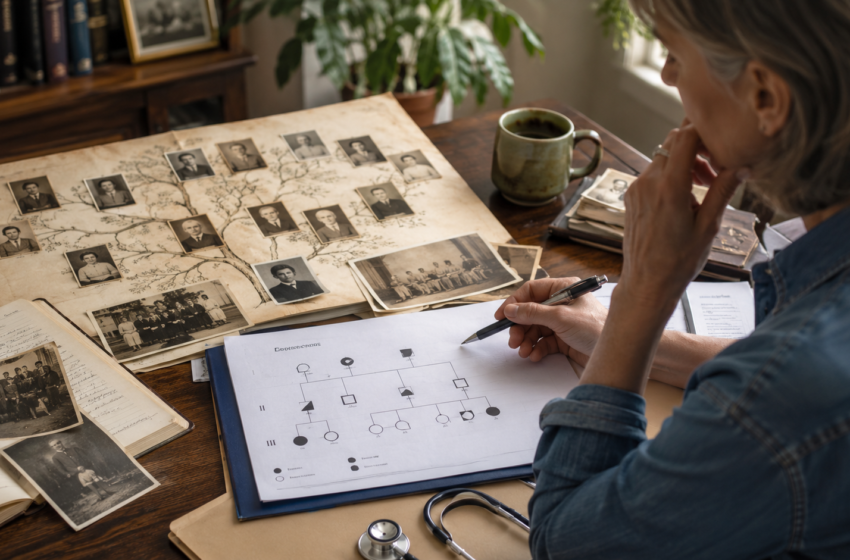
A simple list of conditions is useful, but the information becomes far clearer when you chart it, much as a pedigree chart clarifies relationships. Clinicians use a tool called a genogram or medical pedigree, a diagram that uses standard symbols and, crucially, shows brothers and sisters who often go missing from a conventional tree. Charting the conditions this way lets patterns leap out that would stay buried in a list of names. You do not need anything elaborate to start; free tools exist specifically for this, including the long-running My Family Health Portrait created by the U.S. Surgeon General’s office, which builds a shareable digital record you can hand to a doctor.
Two cautions are worth holding onto throughout. The first concerns feelings and privacy. Health is intimate, and some relatives will not want to discuss it; that wish deserves respect, and the whole effort should be approached with sensitivity rather than interrogation. Be prepared, too, for the occasional uncomfortable discovery, since digging into family health can surface things a family never spoke about. The second caution is about what this record is for. A family medical history is a conversation starter with a healthcare professional, not a self-diagnosis kit. Its real value appears when you share it with your doctor, who can interpret the patterns, recommend appropriate screening, and suggest changes that actually reduce risk.
And that last point is the hopeful one. You cannot change the genes you inherited, but a family health history most benefits the people who learn they are at risk, because so many of the conditions that run in families respond to the things you can change. Earlier screening catches disease sooner. Healthier habits, around smoking, exercise, and diet, measurably lower the odds. In tracing the health of those who came before, you are not just completing your family’s story. You are giving the next generation a head start on theirs.
This article is for general information and is not a substitute for professional medical advice. If you have concerns about conditions that run in your family, a doctor or genetic counselor is the right person to help you interpret them.
